
I often say that if you understand the Financial Model, you understand the deal, business or whatever you're building a Financial Model for. That's because all the business logic is encapsulated in the Financial Model. Besides the traditional uses of a Financial Model, such as raising capital, pricing a service, or forecasting revenue, a Financial Model is also a highly effective negotiating tool. In this blog post, I will explain how to use a Financial Model to negotiate and what to incorporate into your Financial Model to ensure it is the best negotiating partner for you.
In this blog post:
- Why Use the Financial Model to Negotiate
- How to use your Financial Model as a negotiating tool?
- Data visualisation
- Financial Model Inputs
- Scenario Analysis
- Risk Mitigation
- The Financial Model as a Reflection of you and your business
Why Use the Financial Model to Negotiate
First, let's understand why you should use the Financial Model to negotiate.
It's logically more challenging to argue with numbers, and it removes emotions.
Presenting somebody with numbers from the Financial Model removes the emotions from the boardroom table. The narrative is no longer personal, or you are saying, "I think that you're wrong and I'm right." You've got the Financial Model there. The Financial Model is purely numbers based. It's logical formulae and helps remove some of the emotions.
It provides 'proof' of your stance.
The narrative changes to one saying, "If you want these terms, look what it does to the model, look at what it does the deal." You can quite visibly illustrate this using the Financial Model. You can show the Financial Model and that the whole model falls over when you input those terms if that's what you're negotiating.
It enables you to test multiple scenarios.
It also allows you to test multiple scenarios to say, well, maybe that doesn't work, but this will.
It allows you to see what is driving your model – and deal/business
A Financial Model allows you to see what's important and what's not, and you can use this to understand what you need to negotiate hard on.
How to use your Financial Model as a negotiating tool?
Model Outputs and Data Visualisation for Decision-Usefulness

First – make sure it looks presentable and can be understood.
Data visualisation is critical. In other words, there's no point in saying, "The whole deal falls over if we use those terms", and you present a spreadsheet with all these numbers, and nobody has any idea what's going on.
Effective Financial Model visualisation means one can see what each number is and can drill down into the details. Something as simple as changing graph formats to bring out the key message from the Financial Model can make a big difference.
What is a Debt Service Reserve Account? Focus on what is vital:
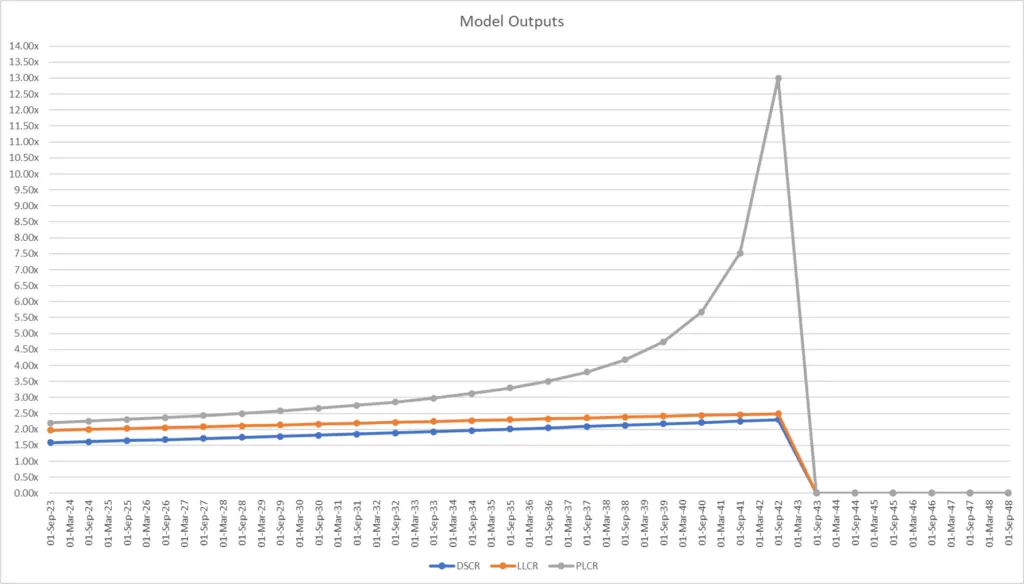
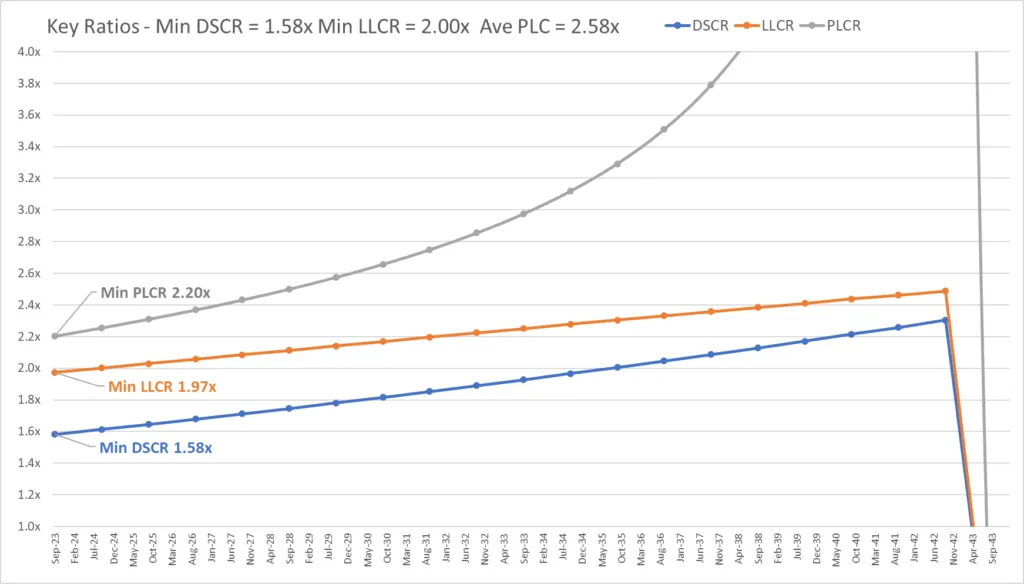
- What's the minimum Debt Service Coverage Ratio or DSCR?
- What's the minimum Loan Life Coverage Ratio or LLCR?
- What's the minimum Project Life Coverage Ratio or PLCR?
Effective Data Visualisation for Financial Modelling - Key Ratios
 Previous
Next
Previous
Next
As can be seen above, the outputs should be visually understandable and decision-useful. A Financial Model needs to enable one to make decisions. If you look at a Financial Model and can't make a decision such as "I need to go ahead with this business", "We need to raise capital", "No, can't raise capital", or "Yes, that interest rate makes sense", then what is the purpose of the model?
A Financial Model is NOT financial reporting. Instead, a Financial Model is forward-looking.
Your Financial Model tells a story. How you tell that story is often through visualisation. And this doesn't mean you have to be an art expert.
Some key talks on data visualisation for financial modellers

Know where the input data comes from and that it is reliable
You want to know where the input data comes from and that it's all there. One will get asked where input data comes from, and you should be able to answer this question quickly.
As somebody using a model to negotiate, you want to know where that input comes from. Assumptions are the bedrock of the model. If someone can't trust the input assumptions, they'll never trust the Financial Model outputs. As we often say in data analytics, "Rubbish in, rubbish out". You can have the best Financial Model in the world, but if you have rubbish inputs, then the outputs are meaningless.

Assumptions are the bedrock of the model – if someone cannot trust the assumptions, they will not trust the model outputs."

Know What Metrics are Key
With so many variables to stress from:
- Exchange rates.
- Interest rates.
- Inflation.
- Project availability
- Resource availability.
Most lenders will run scenario analyses and DSCR break-evens to see at which point the debt does not get repaid. You need to understand what metrics are critical to each party.
For a lender, this will be answering, "What could cause the debt to not to get repaid?"
Risks
The Financial Model needs to clearly show all parties how the deal is either mitigating risks or willing to take on the risk and will be compensated for it.
Show how risks are mitigated using the Financial Model – whether by incorporating hedging costs or insurance premiums. Either show how you have mitigated risks or are prepared to deal with them.

Macroeconomic Inputs
Make sure your model reflects economic reality and use the latest economic indicators and rates.
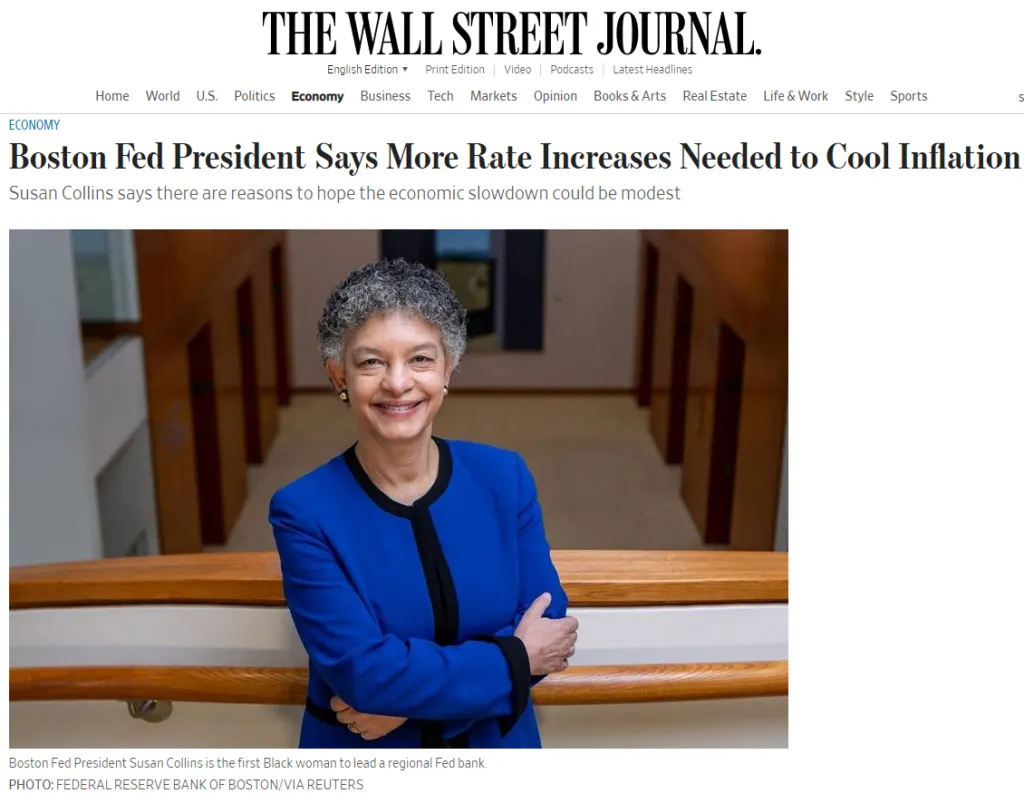
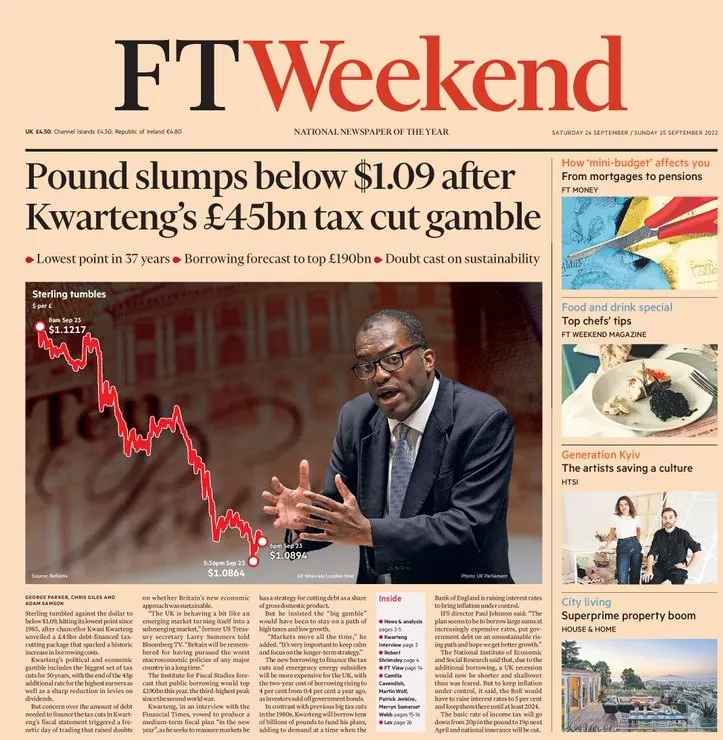
We live in such a fast-changing world. I remember a time when Financial Models would contain a fixed inflation rate. Yet, when writing, Inflation is on the front page of the Financial Times and Wall Street Journal.
Ensuring that your model reflects the current economic reality means using the latest economic indicators and rates. But, again, one cannot assume a fixed exchange rate without it being hedged when newspaper headlines look like the one below!
If significant inputs are wrong, it is difficult to trust the rest of the model. This is easy to do with Microsoft data types!
If someone hasn't paid enough attention to crucial inputs, what else aren't they paying attention to? For example, are they not paying attention to regulatory issues, or they're not paying attention to contracting issues?
The Financial Model reflects your business – and your attention to detail.
Alignment of Interests
Understand that in many aspects, different people involved in a deal want a similar outcome:
- Success
- Largest return possible
- Largest debt or equity possible
- Risks to be mitigated to allocated to the party best placed to handle them
- Security of revenue
Typically, everyone in a project wants the same outcomes. They want success for the project, business, or deal. They want the largest return possible. Everybody wants the risks to either be mitigated or allocated to the party's best place to handle them.

Using the Model Effectively
To use the model to show new constraints' effect on the outcomes, the whole deal team needs to understand and know how to operate the model. It is risky to have only one person in the deal team know how to operate the Financial Model., everybody should know what's going into the model, what the output should be, and have a general sense of how the Financial Model works.

The Model is Your Brand
Always be aware the Financial Model is a reflection of you and your business
Before presenting outputs, ask:
- Is it complete?
- Is it accurate?
- Did you pay attention to the details?
- Is it something you're proud of presenting to investors?
- Can you use the Financial Model for decision-making?
If you are using the Financial Model to finance a deal or start a new business, it represents you.
Attention to detail in the Financial Model often means attention to detail in other business areas.
Tools to check for model accuracy and common errors are readily available (here is one – Arixcel). You don't have to go to expensive auditors (what is the Financial Model audit), which we might need to do at financial close. Instead, we can run auditing tools on Financial Models.
Everybody in the team needs to be proud of the Financial Model because the Financial Model represents the whole deal. It represents the entire business.
And This is why I love Financial Modelling
It's not just our project finance. It's not just for large corporates. It's for an entrepreneur who wants to build a business. It helps them answer questions such as:
- How do I price my product?
- How do I raise capital?
- Do I need to raise capital?
- How much money can I raise?
Good luck and happy Financial Modelling!