
The PLCR, together with the DSCR and LLCR, provide a holistic view of a project's ability to repay and restructure its debt.
The Key Project Finance Ratios
In a Project Finance Model there are three key ratios that are calculated and assessed:
- The Debt Service Cover Ratio or DSCR
- The Loan Life Cover Ratio or LLCR
- The Project Life Cover Ratio or PLCR
This article is the third in a three-part series on these ratios which are key to not only the Project Finance Model, but also the Project Finance Deal.
While the:
- Debt Service Coverage Ratio or DSCR assesses the ability for a project to service debt interest and principal in a single period from operating cashflow, and the
- Loan Life Coverage Ratio or LLCR assesses the ability for the project to service debt over the lifetime of a loan – i.e. for the whole project to meet its entire debt obligations;
- The Project Life Coverage Ratio or PLCR assesses the ability to service debt over the lifetime of a Project and all of the Project’s expected cashflows.
A Project Life Cover Ratio - or PLCR - is calculated for every project finance deal and typically needs to meet various covenants throughout the project life. But what is a PLCR, how is it calculated, and why do we even need it? Let's take a deeper look at one of the least understood project finance ratios.

Project Finance Risks
To understand the PLCR, one needs to understand the constraints and risks a project might face. This is detailed here, but to recap, some of the main risks include:
- Construction risks such as delays, cost overruns or quality issues
- Operational risks such as under-performance, operator challenges or maintenance issues
- Other risks (which can also be categorized as either construction or operational into the above two such as natural disasters, government or regime changes or even significant technological changes).
Due to these risks, or simply opportunity, project debt may extend beyond the period agreed to at Financial Close. At Financial Close, how can we assess whether the project will fall over if the debt amortization period needs to be extended beyond the originally agreed dates? The Project Life Cover Ratio provides insight into how much breathing room a project has.
Calculation of the Project Life Cover Ratio
The PLCR can be calculated without understanding it - and every project finance model will have it. It shares similar characteristics with the LLCR and is assessed in conjunction with the DSCR and LLCR to form a view of a project's robustness to pay its debt. The PLCR = NPV(CFADS over the project life) / Debt Balance at any point in time We discount the CFADS using the WACC for the PLCR we are looking at - senior PLCR will just take the cost of senior debt, whereas Total PLCR will look at the combined WACC. From the above, we can see that the PLCR will be higher than the LLCR - but what does this mean?Taking a Step Back to the LLCR to Understand the PLCR
If we recall what an LLCR is used for, it is used to assess the robustness of a project to service its debt over the project life. Given that the DSCR may vary in every period, taking a periodic view of the capability to repay debt, especially in a period where the CFADS may be higher than average, does not provide a holistic view of debt repayment capability. Therefore, the LLCR is used to look at the debt repayment ability over the loan life - one can think of it as an average DSCR.
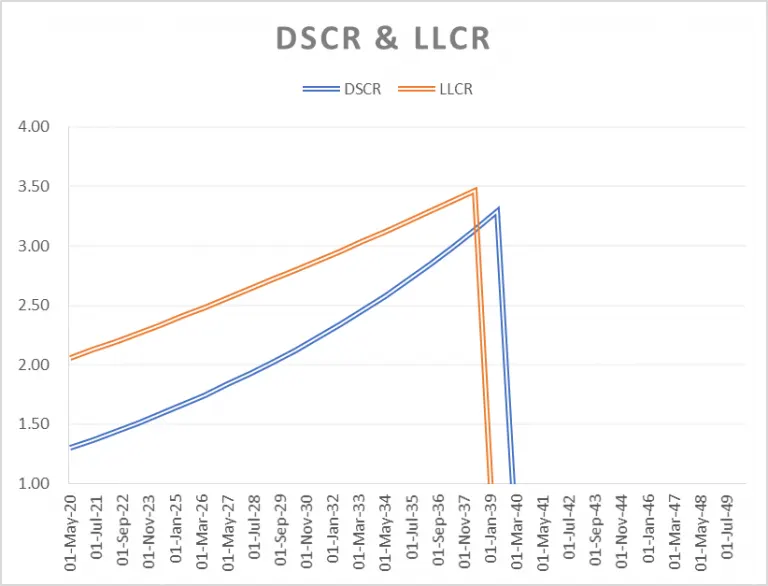
The Project Life typically extends at least a few years beyond the debt amortization date. As such, when compared to the LLCR, the NPV of cash flows for the numerator of this ratio includes cash flows post the loan amortization period for as long as the project is contractually able to earn revenue. Therefore, the PLCR is higher than the LLCR, as:
NPV (CFADS over the entire Project Life) > NPV (CFADS over the entire Loan Life)
And the denominator for both equations is the Debt Balance in the period.
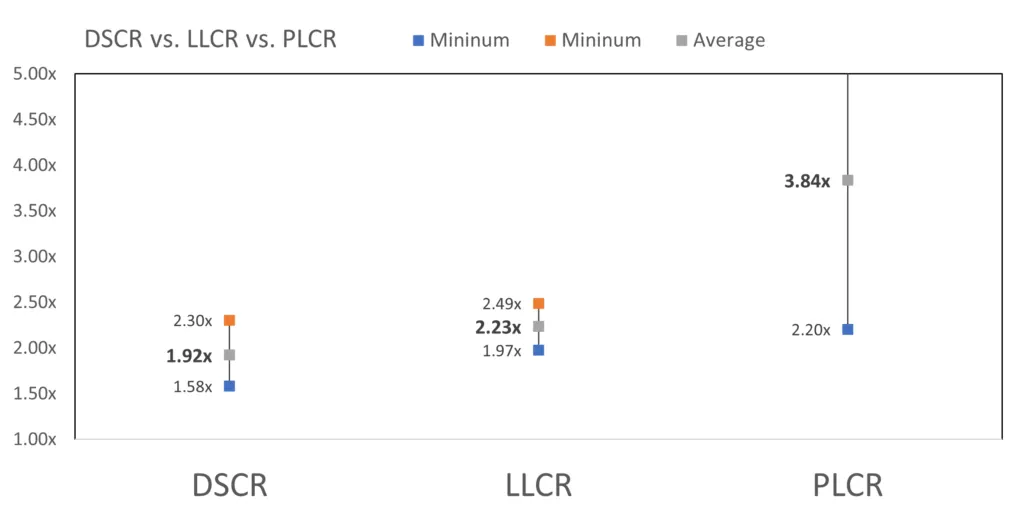
Example model ratio outputs can be seen below.
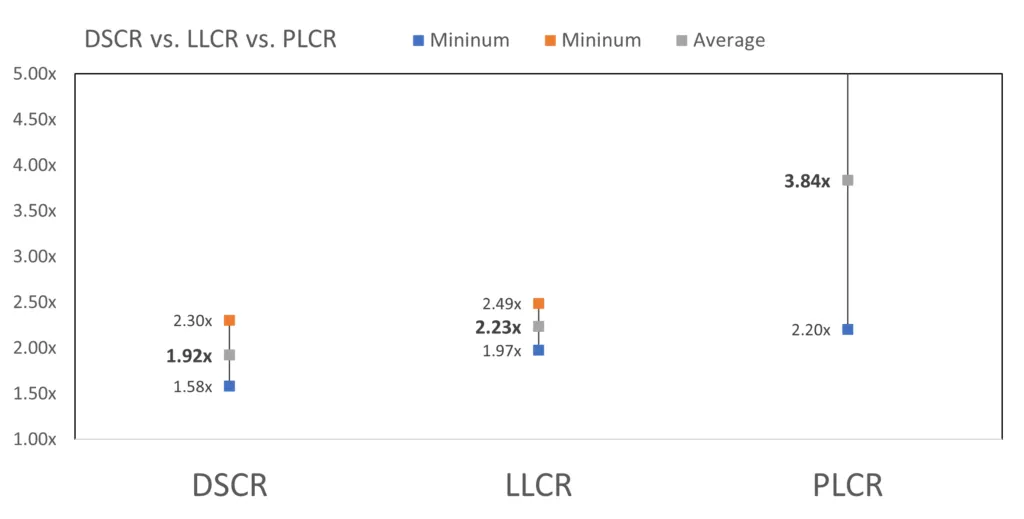
So Then Why a Project Life Cover Ratio?
A PLCR shows the ability to restructure or extend the tenor of the debt beyond the initial loan life. It gives a view of a project beyond the loan life, which may be concerning if the average PLCR is lower than the average LLCR (which may be the case if revenues dip substantially after the loan is paid). A PLCR shows what buffer the project has should the debt not be repaid during the tenor of the loan, and provides one with the final piece of the puzzle to form a complete view of a projects ability to repay debt, especially when combined with: DSCR: Ability to repay debt in a single period and LLCR: Ability to repay the debt over the loan life, which typically ends before the project life (e.g. if the project life is for 20 years of operations, the debt may have a tenor of 15 years).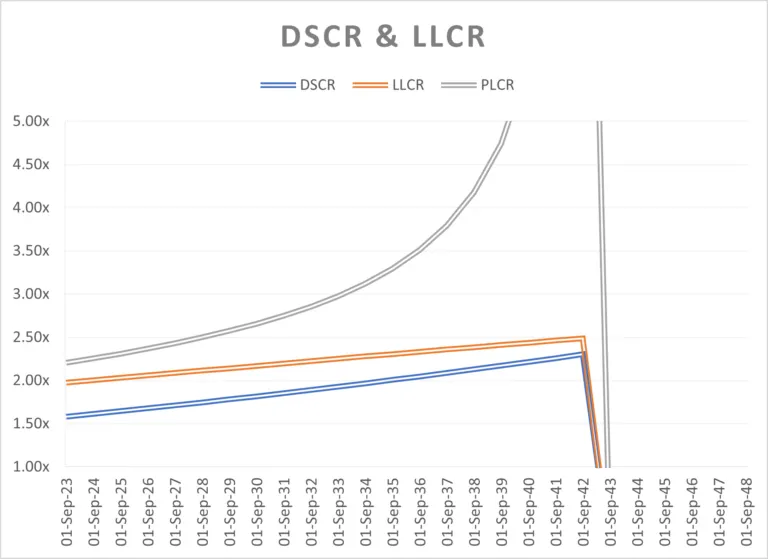
What to Watch Out For When Looking at the Project Life Cover Ratio
There are a few things to watch out for when it comes to the PLCR. The most obvious one is the discount rate to use - especially when the loan life has ended. A discount rate is still required, but we no longer have a benchmark for it. A simple, but not always correct, method is to use the last discount rate before the loan life ended. This is something that should be looked at on a project by project basis. The other item to notice is the inclusion of cash balances in the PLCR calculation, for example, a DSRA. Again, this should be looked at on an individual basis.Example Model Calculations